Coordinated Regional Downscaling Experiment - CORDEX

Summary Description

The COordinated Regional Downscaling EXperiment (CORDEX) is a framework of the World Climate Research Program (WRCP) aimed at the production and evaluation of regional climate model projections. CORDEX is one of the Model Intercomparison Projects (MIPs) of CMIP to advance and coordinate the science and application of regional climate downscaling. The regional projections are produded over 14 domains covering most of the Earth’s major land masses (see figure below). The CORDEX ensemble that provides downscaled CMIP6 global climate model simulations for the North American domain, CORDEX-NA, consists of a subset of the CMIP6 models simulations, and continues to grow as teams contribute their RCM simulations. The previous generation of CORDEX-NA downscaled CMIP5 simulations from 7 GCMs using 9 differen RCMs, filling a matrix of combinations of GCMs and RCMs at 3 different spatial resolutions and using 3 different RCPs over North America. A detailed description of CORDEX is available in Gutowski Jr. et al. (2016).
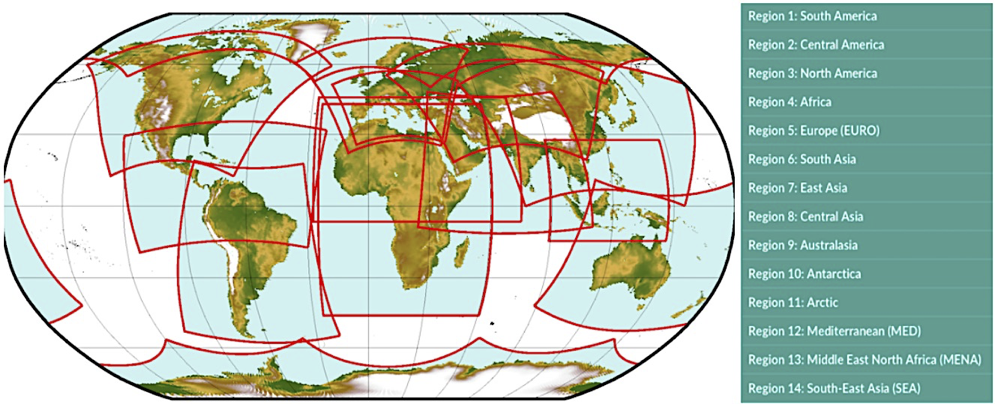
CORDEX Domains

Map of the 14 CORDEX domains (source: CORDEX-CMIP5)

Dataset Characteristics

  • Current version: CORDEX-CMIP6
  • Available variables: standard variables like temperature & precipitation, often many more; availability will vary by model and simulation (see variables section below)
  • Temporal coverage: 1950–2100
  • Temporal resolution: from hourly to annually, all models provide daily. Dependent on model and CORDEX generation.
  • Spatial coverage: 14 continental domains
  • Spatial resolution: 0.11° (~12 km), 0.22° (~25 km), 0.44° (~50 km); availability depends on models and CORDEX generation.
  • Data type: raw model outputs and bias-adjusted climate projections
  • Data format: netCDF
  • Web references:
    CORDEX Portal
    CORDEX North America web site
    Current CORDEX Domain Activities
  • Reference::
    Gutowski Jr. et al. (2016)
  • Contact: Consult the CORDEX Points of Contact Web Page

When to use CORDEX

  • When you need dynamically downscaled climate projections from Regional Climate Models (RCM)
  • When you want to analyze regional climate processes influenced by topography, coastlines, or land–atmosphere interactions at higher spatial resolution (~10–50 km) than GCMs
  • When you want to assess changes in climate extremes (e.g., heatwaves, heavy precipitation, freezing rain) with improved process representation
  • When you need scenario-based projections under different emissions pathways
  • When you need physically consistent projections (across variables and in space/time) derived from RCMs
  • When you accept that an RCM ensemble may not cover the full range of uncertainties of the corresponding GCM ensemble

Strengths and Limitations

Key Strengths of CORDEX

Strength Description
High Spatial Resolution RCMs resolve regional and local climate patterns better than GCMs, particularly in regions of small scale surface features such as mountain terrain and coastal areas.
Comparable Simulations CORDEX simulations follow a shared protocol, making the simulations easy to combine or compare.
Multi-Model Ensemble Provides simulations from multiple regional climate models (RCMs)Changed driven by multiple GCMs.
Compatible with CMIP CORDEX simulations follow the same emission scenarios as their CMIP driving global simulations, hence CORDEX ensembles can be used in combination with CMIP data.

Key Limitations of CORDEX

Limitation Description
Reduced sampling Limited by computational capacities, RCM modeling centers only downscale a subset of GCMs, which means that CORDEX ensembles may not sample the full range of uncertainty.
Time Lag of Availability CORDEX data rely on GCM driving data, thus can only be produced after a new generation of GCM simulations have been made available. Hence, RCM ensembles lag behind the latest available GCM data.
Large Data Volume High-resolution and multi-member ensembles require significant storage and processing capacities.
Biases Remain Dynamical downscaling may reduce, but does not eliminate, GCM biases. It also introduces biases inherent to the RCM.

Expert Guidance

The COordinated Regional Downscaling EXperiment (CORDEX) ensembles of regional climate model (RCM) simulations provide historical climate simulations and projection data at finer spatial scales for impacts and adaptation work. As a global framework, CORDEX coordinates domains, protocols, and evaluation practices, emphasizing that RCMs inherit boundary-condition uncertainty from their driving GCMs and that ensemble interpretation must reflect this dependency (Gutowski Jr. et al. (2016)).

Canada is covered by the North American domain and partially by the Arctic domain. North America CORDEX maintains its own website (NA-CORDEX) which covers the previous generation of RCM simulations that were driven by CMIP5 global simulations and updates for CMIP6 driven simulations are pending. The CORDEX ensemble is built from the contributions of regional modeling centers who choose the respective downscaling experiments they perform. Thus, not all RCMs will downscale the same, and certainly not all, GCM simulations. When using an RCM ensemble it must be noted that, by definition, it may sample a different uncertainty space compared to the driving CMIP ensemble.

Systematic evaluations over Europe showed credible continental-scale temperature and precipitation patterns and documented model-specific biases, illustrating the conditional “added value” of higher resolution for orography, coasts, and extremes (Kotlarski et al. (2014)). Lucas-Picher et al. (2017) explored added value of the Canadian Regional Climate Model’s (CRCM5) simulations over North America. An evaluation of NA-CORDEX-CMIP5 by Bukovsky & Mearns (2020) shows that the downscaled NA-CORDEX ensemble reproduces well the CMIP5 global simulations projections and climate sensitivity. This holds for temperatures at local to continental scales, but only for continental scales for precipitation. The spread of the NA-CORDEX-CMIP5 ensemble is similar to CMIP5 for temperature but larger for precipitation. A description of the NA-CORDEX data archive is provided by McGinnis & Mearns (2021), including bias-corrected simulations.

Published application of NA-CORDEX-CMIP5 in the energy sector include a study of climate change impacts on wind ressources (Chen (2020)) and a cooling and heating energy demand analysis (Tian et al. (2022)). Ganguli & Coulibaly (2019) did an assessment of future changes in intensity-duration-frequency curves for Southern Ontario using NA-CORDEX data. Other analysis and research using NA-CORDEX including hydrological studies can be found on the NA-CORDEX web site’s comprehensive bibliography.

Generally, the strengths of CORDEX are finer resolution than GCM ensembles that can better represent topography, land–sea contrast, mesoscale circulations, and some extremes. Simmilarly to CMIP, coordinated protocols enable multi-model comparisons. The region-tailored ensembles and the globally consistent CORDEX-CORE set for broad coverage are further favorable features of this dataset.

Some noteworthy limitations of CORDEX data include the inheritance of GCM biases and scenarios — RCMs do not “fix” incorrect large-scale circulation. Similarly RCM simulations are not independent from their drivers while on the other hand incomplete cross-pairings of GCMs and RCMs lead to different ensemble characteristics.

Application of CORDEX should start from the most complete regional matrix available and verify evaluation runs (reanalyses-driven) to understand baseline skill. The selection of driving GCMs should span regional circulation patterns and sensitivities, and insure robustness by using multiple RCMs and multiple realizations where available. GCM selection approaches for CORDEX-CMIP6 have been documented by Di Virgilio et al. (2022) for Australia and by Sobolowski et al. (2025) for EURO-CORDEX. In a more generic domain independent approach Goldenson et al. (2023) describe a use-inspired and process-oriented GCM selection approach for the prioritization of global models for regional dynamical downscaling.

CORDEX RCMs are also forced with boundary conditions from reanalysis datasets. These evaluation runs will resemble the historically observed climate and allow to compare RCMs with real world climate, helping to understand model characteristics like internal variability or systematic biases.

Paquin et al. (2025) provide an overview over the latest ensemble of CMIP6-driven RCM simulations over North America.

Variables available in CORDEX

CORDEX regional models may produce variables from the the IPCC list of standard output from Coupled Ocean-Atmosphere GCMs. It comprises far over 100 different variables, and many more may be produced by a model and according to the CF-Conventions (see the Climate and Forecast (CF) Standard Name Table). Depending on the model and its realizations, the respective list of available variables will be determined by the modeling center’s available resources and research focus. Hence, from some models many atmospheric and surface variables will be available, however the common denominator for most CORDEX model simulations will be the variables listed below.

Click on variable groups to uncollapse

Temperature variables are provided at hourly to daily intervals, depending on the model and realization.

  • mean temperature (day, 6hr, 3hr, 1hr) [K]
  • daily minimum temperature [K]
  • daily maximum temperature [K]

Precipitation is commonly provided as the sum of solid and liquid precipitation or as snowfall and variables are provided at hourly to daily intervals, depending on the model and realization.

  • Precipitation flux (day, 6hr, 3hr, 1hr) [kg m-2 s-1]
  • Snowfall flux [kg m-2 s-1]

Other variables often provided by a large number of models include:

  • Wind (estward, westward) [m s-1]
  • Specific or relative humidity [%]
  • Longwave and shortwave radiation (downwelling and upwelling) [W m-2]

Further variables related to evaporation, runoff, and cloud cover may be available depending on the model.

Data Access

The web portal for CORDEX North America provides information for data access, pointing to NCAR’s Goescience Data Exchange and respective Earth System Grid Federation (ESGF) Federated Metagrid Nodes. The CMIP6 driven simulations using the Canadian Regional Climate Model (CRCM - Paquin et al. (2025)) are available on PAVICS for the North American continent. To avoid downloading very large datasets in their entirety PAVICS allows partial/regional extraction and provides tutorials to do so. With a free PAVICS user account, the Jupyter notebook with the Python code from the tutorials can be directly used on PAVICS.

References

(click to expand)
Bukovsky, M. S., & Mearns, L. O. (2020). Regional climate change projections from NA-CORDEX and their relation to climate sensitivity. Climatic Change, 162(2), 645–665.
Chen, L. (2020). Impacts of climate change on wind resources over north america based on NA-CORDEX. Renewable Energy, 153, 1428–1438.
Di Virgilio, G., Ji, F., Tam, E., … Delage, F. (2022). Selecting CMIP6 GCMs for CORDEX dynamical downscaling: Model performance, independence, and climate change signals. Earth’s Future, 10(4), e2021EF002625.
Ganguli, P., & Coulibaly, P. (2019). Assessment of future changes in intensity-duration-frequency curves for southern ontario using north american (NA)-CORDEX models with nonstationary methods. Journal of Hydrology: Regional Studies, 22, 100587.
Goldenson, N., Leung, L. R., Mearns, L. O., … Rahimi, S. (2023). Use-inspired, process-oriented GCM selection: Prioritizing models for regional dynamical downscaling. Bulletin of the American Meteorological Society, 104(9), E1619–E1629.
Gutowski Jr., W. J., Giorgi, F., Timbal, B., … Tangang, F. (2016). WCRP COordinated regional downscaling EXperiment (CORDEX): A diagnostic MIP for CMIP6. Geoscientific Model Development, 9(11), 4087–4095.
Kotlarski, S., Keuler, K., Christensen, O. B., … Wulfmeyer, V. (2014). Regional climate modeling on european scales: A joint standard evaluation of the EURO-CORDEX RCM ensemble. Geoscientific Model Development, 7(4), 1297–1333.
Lucas-Picher, P., Laprise, R., & Winger, K. (2017). Evidence of added value in north american regional climate model hindcast simulations using ever-increasing horizontal resolutions. Climate Dynamics, 48(7), 2611–2633.
McGinnis, S., & Mearns, L. (2021). Building a climate service for north america based on the NA-CORDEX data archive. Climate Services, 22, 100233.
Paquin, D., McCray, C. D., Gauthier, C. B., … Matte, D. (2025). The ouranos CRCM5-CMIP6 ensemble: A dynamically downscaled ensemble of CMIP6 simulations over north america. Scientific Data, 12(1), 1984.
Sobolowski, S., Somot, S., Fernandez, J., … Oudar, T. (2025). GCM selection and ensemble design: Best practices and recommendations from the EURO-CORDEX community. Bulletin of the American Meteorological Society, 106(9), E1834–E1850.
Tian, C., Huang, G., Piwowar, J. M., … Ren, J. (2022). Stochastic RCM-driven cooling and heating energy demand analysis for residential building. Renewable and Sustainable Energy Reviews, 153, 111764.